
Online Quran classes for adults are for learners who are not starting from nothing. Most adults who look for online Quran classes learned to read as children, then stopped — for school, for work, for family — and now the letters feel unfamiliar, the pronunciation feels uncertain, and starting again feels harder than it should.
It is not harder. It is just different from learning as a child, and a good adult programme is built around that difference: shorter, focused lessons, a teacher who treats you as an adult, and a pace set by your life rather than by a syllabus written for someone else. In good online Quran classes for adults, that is what the programme is built around.
This guide covers where adults usually start, what a good lesson looks like, how to fit learning around work and family, and how to choose a teacher — whether you are in the United States, the United Kingdom, Canada, or Australia. It also explains how to choose online Quran classes for adults that fit around work and family, and a teacher who suits your level.
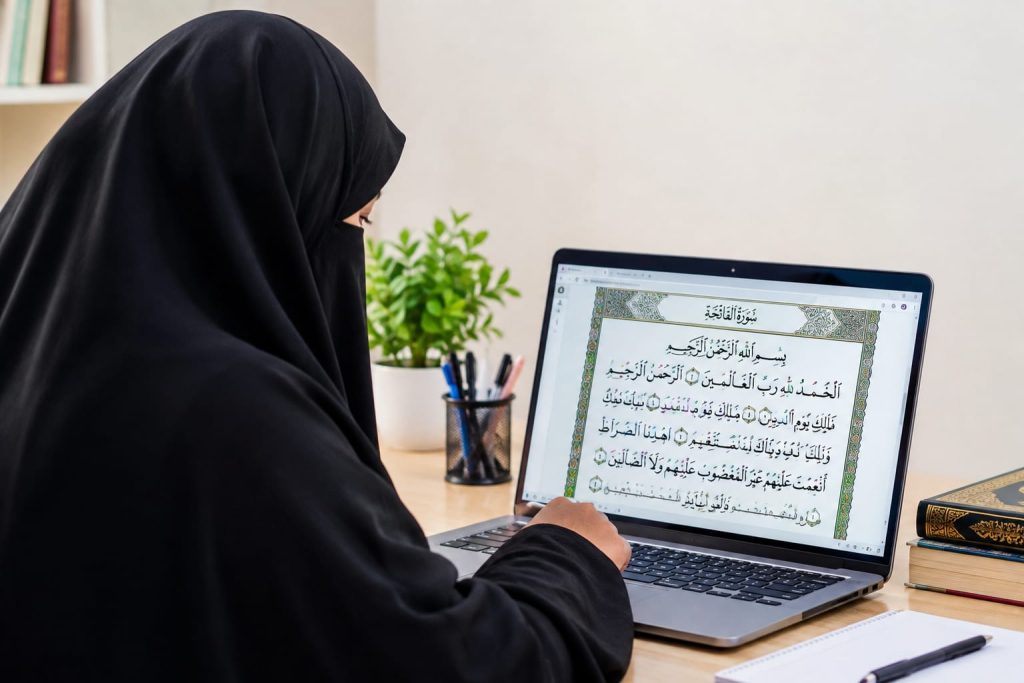
1. Where adults usually start — and why it is not page one
A teacher who starts every adult on page one has not listened to them yet. Most adult learners fall into one of three places, and the starting point should follow an assessment, not a guess: In online Quran classes for adults, that assessment should come before any plan is agreed.
- Relearning to read. You recognise the letters but reading is slow, joining words feels effortful, and you are unsure of the basic rules. The usual path is a foundation course first — at Imamia Quran, that is the Yassarnal Quran course — followed by Quran with Tajweed.
- Reading, but not confidently. You can read, but you hesitate, you are unsure whether your pronunciation is right, and you avoid reading aloud. Here the work is Tajweed and fluency: reading regularly with a teacher who corrects you in the moment, rather than starting over from the alphabet.
- Reading fluently, wanting understanding. You can read well and now want to understand what you are reading — translation, Tafseer, or Nahjul Balaghah. This is a different kind of lesson, closer to study than to reading practice, and it needs a teacher who can explain, not just listen.
If an academy cannot tell you, after hearing you read for a few minutes, which of these you are, keep looking. An assessment lesson is the fastest way to find out — and the cheapest mistake to avoid is months spent on the wrong level. Keep looking until an academy can place you in online Quran classes for adults at the right level.
2. What a good lesson looks like in online Quran classes for adults
Adult lessons fail in two opposite ways: they are either a children’s lesson given to a grown-up, or a lecture with almost no reading in it. A good one-to-one adult lesson usually has this shape: That shape is what makes online Quran classes for adults work for a busy learner.
- You read aloud for most of the lesson. Reading silently does not test pronunciation, and listening to the teacher read does not build your fluency. Expect to do most of the reading, with the teacher listening and correcting.
- Corrections happen immediately, and kindly. A good teacher stops you at the mistake, explains it briefly, and has you read the word again — then checks it once more later in the lesson. Corrections saved for the end of the lesson are mostly forgotten.
- There is a small, clear task for the week. One passage to practise, one rule to work on, one section to revise — not a vague instruction to “practise”. You should leave the lesson knowing exactly what to do before the next one.
- Questions are part of the lesson, not an interruption. Adults learn by asking why — why a word is read this way, what a passage means, how a rule works. A teacher who welcomes that is teaching an adult; a teacher who rushes past it is not.
Ask before you enrol how much of a lesson is student reading, and how the teacher handles questions. The answer tells you more than any course description. Before you enrol in online Quran classes for adults, ask how much of a lesson is student reading, and how the teacher handles questions.
3. Fitting lessons around work, family, and time zones
The most common reason adults stop is not difficulty. It is the schedule falling apart. A programme that works for adults is designed for that reality: The best online Quran classes for adults are the ones whose schedule you can keep in a normal week.
- Short, regular lessons beat long, irregular ones. Two or three shorter lessons a week, at a fixed time, usually hold better than one long session that keeps getting moved. If you can only manage one lesson a week, say so at the start — a teacher who knows that can plan around it, and one who expects three will be disappointed.
- Fix the time, and protect it. Early morning before work, a lunch break, or after the children are in bed — the best time is the one you can keep on a bad week, not the one that looks good on a calm one. For learners in the US, UK, Canada, and Australia, that also means agreeing the time zone explicitly, including what happens when clocks change.
- Plan for missed lessons in advance. Work travel, illness, school holidays, and family commitments will interrupt a long programme. Ask how missed lessons are handled — rescheduled, made up, or lost — and how revision is kept up during a break, so a gap does not turn into a restart.
- Practise in small pieces. Ten to fifteen minutes of reading aloud most days does more than an hour once a week. Reading the week’s passage a little each day, and revising the previous week’s passage once, is a routine most adults can keep — and it is the routine that produces progress.
If you are learning alongside a spouse, a sibling, or a parent, say so. Some adults learn better with a partner to practise with; others need their own teacher and their own pace. Either is fine, but it should be a choice, not an accident. Tell the academy if you are learning with family — online Quran classes for adults can be shared, but each learner still needs their own level and plan.
4. The embarrassment problem — and how to get past it
Many adults delay starting for a reason they rarely say out loud: they feel embarrassed that they cannot read well, or that they are starting again at their age. It is worth naming, because it shapes the whole experience.
A good teacher has heard this before, many times, and does not treat it as unusual. Signs that a teacher is right for an adult learner: A good teacher in online Quran classes for adults has heard that worry many times and does not treat it as unusual.
- They ask about your background before they ask you to read.
- They correct without making a performance of the correction.
- They measure progress against where you started, not against other students, and they notice improvement out loud.
- They do not rush you through material to keep to a timetable you never agreed to.
For women who prefer a female teacher, Imamia Quran lists its female teachers separately — that choice should be available without having to ask twice. And if you are a parent who has enrolled a child, learning alongside them is one of the strongest things you can do for that child’s motivation: children keep going when they see a parent doing the same work. For women who prefer a female teacher, that choice should be available in online Quran classes for adults without having to ask twice.
There is no age at which starting again becomes foolish. The only wasted time is the time spent waiting to feel ready. Starting again is never foolish — and online Quran classes for adults are made for exactly that fresh start.
5. Tajweed, Tafseer, or Hifz — which comes next?
Once reading is steady, adults usually want one of three things, and the order matters:
- Tajweed first, for most learners. Correct pronunciation is the foundation everything else rests on. If you memorise or study a passage with a pronunciation mistake in it, you have to unlearn the mistake later. The Quran with Tajweed course is the usual step after the foundation course.
- Understanding next. Translation and Tafseer turn reading into study. This suits adults who already read fluently and want to know what the words mean and how they are understood. It is a slower, more reflective kind of lesson — ask for a teacher who is comfortable explaining, and comfortable saying when a question needs a qualified scholar rather than a quick answer.
- Hifz, when reading is solid. Memorisation is a long project, and it works best when reading is already fluent — otherwise you risk memorising mistakes. The Quran memorisation course follows the same revision pattern for adults as for children: new lesson, recent revision, and older revision, kept in balance. Be cautious of any programme that promises every adult the same completion date; a personal estimate after an assessment is useful, a fixed promise made before anyone has heard you read is not.
You do not have to choose all three at once. Pick the one that matches why you came back to learning, and let the teacher suggest when the next step is ready. That choice is where online Quran classes for adults should start from.
6. Choosing an online Quran teacher as an adult
Before you enrol, ask:
- Is the class one-to-one, and will I have the same teacher each week?
- Is there an assessment before I start, so the plan fits my reading level?
- How much of each lesson will I spend reading aloud?
- Can I choose a male or female teacher, and can I change teacher if the fit is wrong?
- What happens if I miss a lesson, travel, or need to pause for a few weeks?
- Can I take a trial lesson first, so I can hear how the teacher teaches and corrects before I pay?
A teacher who answers these plainly, and who offers a trial lesson, is a good sign. A programme that asks for payment before any lesson, any assessment, or any answers is not.
FAQs
I am an adult and I can barely read Arabic. Is it too late to start?
No. Adults relearn to read regularly, and they often progress faster than children because they understand the rules once they are explained. The starting point is a foundation course and an assessment, not the beginning of a children’s syllabus. That faster progress is common in online Quran classes for adults once reading is regular.
How many lessons a week do adults take in online Quran classes for adults?
Two or three shorter lessons a week is the most common pattern, but one fixed lesson a week, kept reliably, works better than three that keep getting cancelled. Agree the number with your teacher at the start, and review it after a month. Two or three shorter lessons a week is the most common pattern in online Quran classes for adults.
Can I learn Tajweed as an adult beginner?
Yes — Tajweed is usually the step after you can read, and it is taught the same way to adults as to anyone else: by reading aloud with a teacher who corrects you in the moment. The Quran with Tajweed course is the usual route. Ask for online Quran classes for adults with Tajweed once your reading is steady.
I want to understand the Quran, not just read it. Where do I start?
Start by making sure your reading is steady, then move to translation and Tafseer study with a teacher who can explain. The Quran Tafseer course is the relevant next step — and a good teacher will say when a question should go to a qualified scholar.
Can I choose a female teacher?
Yes. Imamia Quran lists its female teachers separately, and you can ask for one when you enrol. If an academy cannot confirm that choice before the first lesson, treat that as a gap.
What if I miss lessons because of work or travel?
Ask before you enrol how missed lessons are handled and how revision is kept up during a break. A programme with a clear answer to that question is built for adults; one without it will quietly fall apart the first time life gets busy. The same question matters most in online Quran classes for adults, where work and travel interrupt learning.
What to do next
Get your reading assessed, agree a small weekly plan that fits your real schedule, and take a trial lesson to hear how the teacher teaches before you commit. If you are considering Imamia Quran, look at the Quran with Tajweed course or the Quran Tafseer course depending on where you are starting from, and contact the academy to arrange an assessment and trial lesson. Take a trial lesson and see whether online Quran classes for adults with Imamia Quran fit your schedule and your level. You can also read along on Quran.com between lessons.